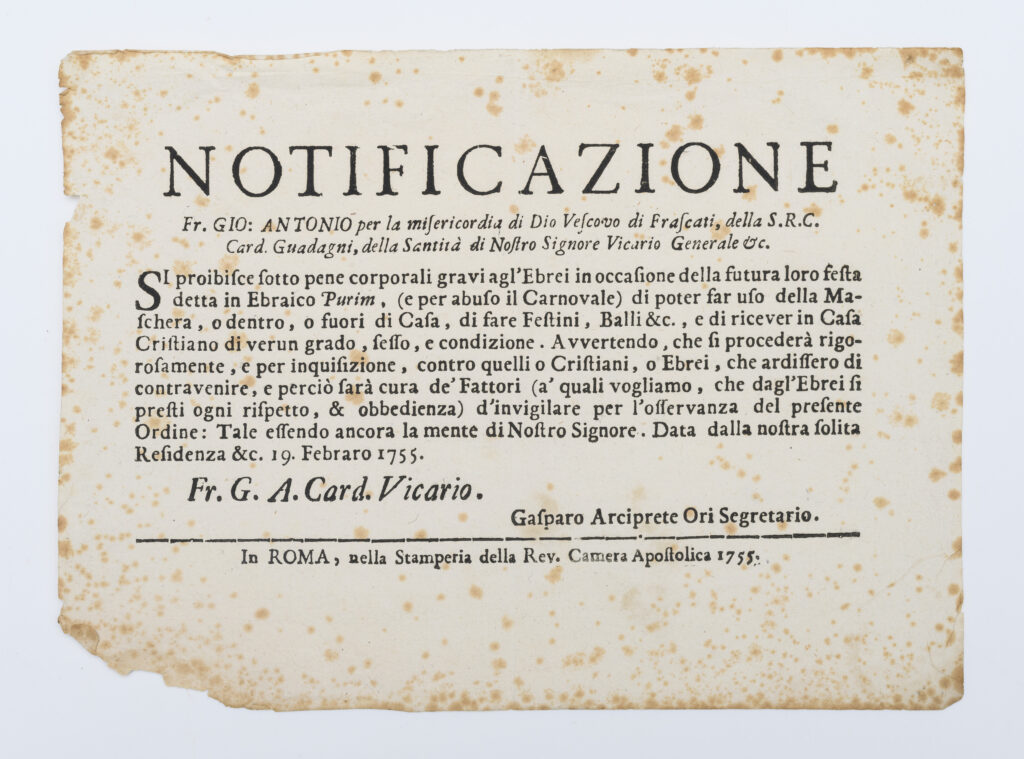
Notification Containing the Prohibition of Wearing Masks and Receiving Christians on Purim
Rome: Printery of the Reverend Apostolic Chamber, 1755
One printed sheet, 27 × 19.5 cm
Jewish Museum of Rome, inv. 2401.
Gift of Clotilde Piperno’s family in memory of her father, Angelo Tagliacozzo, and mother, Fortunata Di Porto, 2014
On February 19, 1755, Cardinal Antonio Guadagni, the Pope’s Vicar General, i.e. the competent authority in Jewish matters, issued an edict signed by secretary Gaspare Ori for bidding “the Jews, under severe corporal punishment, on the occasion of their future festival, known in Hebrew as Purim (and by abuse as Carnovale), to wear Masks, either inside or outside the house, to hold parties, balls, and to receive Christians of any rank, sex, or condition in the house.” Severe punishments were threatened for transgressing Christians and Jews, and even the intervention of the Inquisition. Furthermore, the Fattori, i.e. the leaders of the community, had to ensure that this order was observed. It is noteworthy that Jews were advised to pay respect and obedience to their authorities, thus indicating that this was often not the case, especially during the feast of Purim. These edicts on the “Carnival of the Jews”—which was very popular among Christians, both men and women, who entered the ghetto and the homes of their acquaintances— were re-issued in the same form every year, which is further evidence of their total uselessness. Indeed, routinely disregarding the order, Jews quietly continued to disguise themselves, and Christians continued to enter the ghetto to attend parties, balls, and private banquets, evading surveillance at the gates. A “tacit tolerance” by the authorities on both sides allowed for the management of those potentially dangerous days. Only in the revolution period, for fear of “riots in the ghetto,” a brief permission to was granted.
MC