Yoav Di Tivoli (?) (copyist)
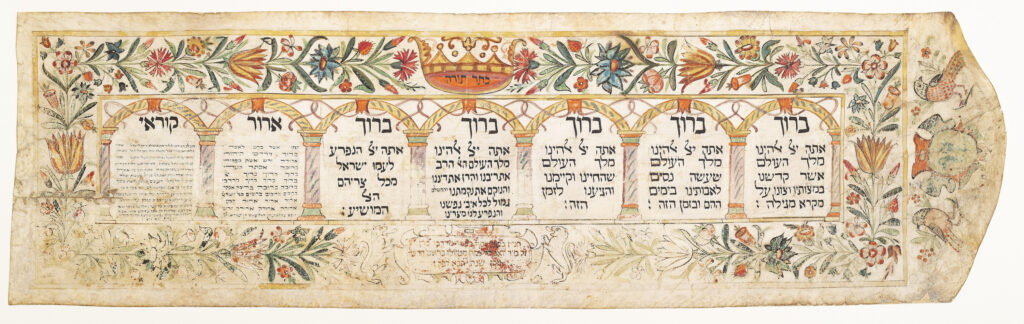
Meghillah (scroll) of Esther with Initial and Final Blessings, and Qoreh Megillah Hymn
Rome, 1641
Wood, ink, and watercolor on parchment, 51 × 560 cm (megillah) 26 × 88 cm (blessing sheet) Inscription on the megillah: “Purchased from… Yitzchak … [Cohen?] … Volterra, in the year…” Inscription on the berachot: “Purchased by Iosef, son of Mordechai Coen from the hands of Yoav son of Zemach Di Tivoli, Beginning of the month of Nissan 5421 (1641).”
Museo Ebraico di Roma, inv. 1501A, 1501B
This megillah with its berachot (blessing sheet) fits fully into a substantial group of Esther scrolls, all copied in Rome in the mid-seventeenth century. They all have in common the decoration of the first cover quarter and the production of an independent blessing sheet. On this insert, the decoration characterized by a series of portals, foliage, flowers, and zoomorphic figures expands and takes on its full shape. In the opening or central shields, family crests (in this case, the blessing hands of the Coens) are inserted, as well as the phrases of dedication and testifying purchase. Therefore, we can refer to a “Roman model” that evidently involves an aggregate of scribes—and, perhaps, mediators—with shared codicological and graphic techniques, and even common dedicatory formulas.
AS, OM